
The short version
- The goal
- Full speed, at the line, at the gun, in clear air. Miss any one of the four and you start the race behind.
- Before the sequence
- Find the favored end, take a line sight, and do a practice run to the line.
- The last minute
- Hold your spot, keep a gap to leeward to accelerate into, and go at the right moment.
- The common mistake
- Arriving early and having to stop. A boat that's late but at full speed usually beats one that's on the line and parked.
The four things a good start needs
Every good start has the same four ingredients, and every bad one is missing at least one of them:
- Position — the right place on the line, usually near the favored end but not in the crowd fighting for it.
- Timing — reaching the line as the gun goes, not before and not ten seconds after.
- Speed — crossing at full speed rather than still accelerating.
- Clear air — no boat just to windward of you, stealing your wind.
You can rarely have all four perfectly. When you have to choose, speed and clear air usually matter more than position: a boat at full speed in clean wind a third of the way down the line will often lead one that started at the favored end and got stuck.
The start sequence
Most races use the standard five-minute sequence from the Racing Rules of Sailing (rule 26):
| Time to start | Signal | What it means |
|---|---|---|
| 5:00 | Warning — class flag up, one sound | Start your timer. |
| 4:00 | Preparatory — P, I, Z, U or black flag up, one sound | The start rules are now in force. |
| 1:00 | Preparatory flag down, one long sound | One minute to go. |
| 0:00 | Class flag down, one sound | Start. |
Always check the sailing instructions — some events use a different sequence.
Time from the flags, not the horn. The rules say the times come from the visual signals, and a missing or late sound doesn't count. Sound travels slowly across a big line, so sync your watch when the flag moves, and re-sync at the four-minute and one-minute signals.
Know where the line is
From the middle of the line, you can't see it. The ends are a long way apart, and everyone around you is guessing too — which is why the middle of the line usually sags, with boats sitting well behind it at the gun. A sailor who knows exactly where the line is can be first there.
The classic way to know is a line sight. Before the sequence, sail to one end and look along the line past the other end to something on the shore behind it — a building, a tree, a headland. On your approach, when that landmark lines up with the far end of the line, you're on it.
GPS does the same job with numbers. Mark both ends, and an app can tell you how many metres or feet you are from the line, and how many seconds it will take you to get there at your current speed.
Two ways to approach
The timed run
Sail away from the line on a reach for a set time, turn, and sail back at the same speed for the same time. If you sail away for 60 seconds starting with 2:30 to go, turn at 1:30, and you'll reach the line at about 0:30 — then you have thirty seconds to burn, or you start the run a little later. Practise it in the warm-up so you know how long your boat takes to turn and get back up to speed.
Hold your spot
In a crowded fleet, most boats line up a minute or so before the start and sit close to the line, sails luffing, holding position. This is where holding station matters: small rudder movements, a sail backed lightly to stop yourself drifting forward, eyes on a fixed reference rather than on the boats around you.
The trick is to protect a gap to leeward — empty water just downwind of you. Luff up slowly to create it, and keep other boats from filling it. That gap is where you'll bear away and accelerate in the last seconds, without running into the boat below you.
The last minute
- Know your time to the line. Not just in the final seconds: keep checking how far you are from the line and how long it takes you to get there.
- Accelerate the right way. Bear away a little to get flow over the sails, sheet in progressively as the boat speeds up, and only then come up to your close-hauled angle. Sheeting in hard from a standstill just stalls the sails.
- Go a little early. It takes most boats several seconds to get from luffing to full speed. Start your acceleration so that you reach full speed as you reach the line.
- Watch the boats around you. If the boat to windward is creeping down on you, or the boat to leeward is closing your gap, adjust — a fixed plan in a moving fleet is how you end up parked.
The first thirty seconds after the gun
The start isn't over at the gun. In the next thirty seconds the fleet sorts itself out, and the boats with clear air pull away from the ones without. Settle into your upwind groove straight away and keep your speed up. If a boat is sitting on your wind, don't wait to see whether it gets better: if you can, tack or bear away slightly to find clear air.
Rules at the start
The start is the most crowded minute of the race, so it's where the rules matter most. These are the ones a first-timer needs. Rule numbers are from the Racing Rules of Sailing 2025–2028.
You're racing from the preparatory signal
From the preparatory signal (four minutes to go) you are racing, and the right-of-way rules in Part 2 apply in full. Port keeps clear of starboard (rule 10). Windward keeps clear of leeward (rule 11). A boat clear astern keeps clear of the boat ahead (rule 12). Everyone avoids contact if they reasonably can (rule 14). See port vs starboard and the windward-leeward rule.
No proper course before the gun
A boat has no proper course before its starting signal. So a leeward boat may luff you, even right up to head to wind. It must still give you room to keep clear when it changes course (rule 16.1) and when it has just gained right of way (rule 15), and it must avoid contact (rule 14). Rule 16.2, which stops a starboard boat from turning toward a port boat that's ducking it, applies only after the start.
No room at the committee boat
The mark-room and obstruction rules (rules 18 to 20) don't apply at a starting mark with water all around it, or at its anchor line. That holds from when boats are approaching it to start until they have left it astern. It's in the introduction to Section C of Part 2. So if you sail into the gap between the committee boat and a leeward boat, called barging, you have no right to room. The leeward boat may hold its course and shut the gap, and you have to keep clear.
Over early
If any part of your hull is on the course side of the line at the gun, you haven't started. Sail back until your hull is completely on the pre-start side, then start. While you're going back you have no rights: you must keep clear of every boat that isn't (rule 21.1). A boat taking a penalty turn must keep clear in the same way (rule 21.2).
The preparatory flag, in one line each
- P: the normal start. If you're over at the gun, go back and start.
- I: if you're over in the last minute, you must return round either end of the line (rule 30.1).
- Z: in the last minute, being in the triangle between the line and the first mark costs a 20% scoring penalty (rule 30.2).
- U: the same triangle means disqualification, unless the race is restarted (rule 30.3).
- Black: disqualification that sticks even after a general recall (rule 30.4).
Recalls and the rest of the flags are in race flags. The basics of a first race are in your first race.
Mistakes that bury most club starts
- Arriving early. Having to kill speed with thirty seconds to go leaves you slow and an easy target. Be late and fast rather than early and stopped.
- Sitting in the middle of the line, well behind it. The mid-line sag catches most of the fleet. A line sight or GPS distance gets you ahead of it.
- No gap to leeward. Without room below you, you can't bear away to accelerate, so you're still slow at the gun.
- Fighting for the favored end in a crowd. If the whole fleet is at the pin, a clean start just up the line is usually better.
- Starting the timer on the horn. Time from the flags.
Doing it with Sail Tactician
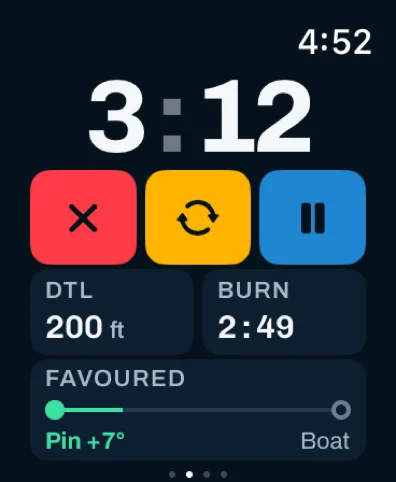
Sail Tactician runs the whole sequence on an Apple Watch or iPhone, and measures the start afterwards.
Questions
How do you time a sailboat race start?
Start your timer on the warning signal, five minutes before the start, timing from the flag rather than the sound, and re-sync it at the four-minute and one-minute signals. Then judge how long it will take you to reach the line and start your final approach so you arrive at full speed as the start signal is made.
What is a line sight?
A landmark on the shore that lines up with the start line. Seen from one end of the line, past the other end, it tells you you're on the line when it lines up with that far end during your approach.
Is it better to be early or late at the start?
Slightly late at full speed is usually better than early. A boat that arrives early has to slow down or stop, and then can't accelerate as quickly as the boats around it.
What is a gap to leeward?
Empty water just downwind of your boat on the start line. You create it by luffing up slowly before the start, and use it in the last seconds to bear away and accelerate without hitting the boat below you.
Sources
Start sequence from the Racing Rules of Sailing 2025–2028, rule 26. Starting rules from the same rulebook (rules 10–16, 21.1, 21.2 and 30, the introduction to Section C of Part 2, and the definitions of Racing and Proper Course), described in our own words; the current Section C wording is confirmed by Dave Perry's commentary for US Sailing and the RYA's summary of the 2025 changes. Acceleration and holding-station technique from Sail Tactician's in-app training guide. Sail Tactician behaviour from the in-app User Guide, version 3.2.
What changed
- First published.
Put a racing instrument on your wrist.
Start line, wind shifts and VMG at a glance, and a coach in your pocket afterwards. Free to download for Apple Watch and iPhone, with the full debrief on your first five races.
Download on the App Store