
The short version
- What it is
- The end of the start line that sits further upwind. Start there and you begin the race ahead of every boat that started at the other end.
- How to find it
- Point the boat straight into the wind on the line. The end your bow points closer to is favored. A compass or two GPS pings give you a number instead of a hunch.
- What it's worth
- Line length × sin(bias). 5° on a 100 m line is about 9 m — two dinghy lengths. Learn that number and you'll know when it's worth fighting for.
- When to ignore it
- When the gain is less than a boat length, when the whole fleet is piled up at that end, or when you want to go the other way up the course.
Why one end is better
A race committee tries to set the start line square to the wind — at right angles to it — so every boat on the line is the same distance from the windward mark. They rarely manage it exactly, and even when they do, the wind shifts a few minutes later. So almost every line is skewed, and one end sits a little further upwind than the other. That end is the favored end, and the angle the line is skewed by is the line bias.
A boat that starts at the favored end isn't faster. It simply begins the race closer to the windward mark than a boat at the other end, by a distance you can work out.
How much it's worth
Most sailors describe bias in degrees — "the pin's favored by five". Degrees describe the line, but distance is what tells you whether it matters. The two are linked by one line of trigonometry:
gain = line length × sin(bias)
| Bias | 100 m line (330 ft) | 200 m line (660 ft) |
|---|---|---|
| 2° | 3.5 m · 11 ft | 7 m · 23 ft |
| 5° | 8.7 m · 29 ft | 17 m · 57 ft |
| 10° | 17 m · 57 ft | 35 m · 114 ft |
| 15° | 26 m · 85 ft | 52 m · 170 ft |
Rounded. A Laser/ILCA is 4.2 m (14 ft) long and a J/24 7.3 m (24 ft), so 5° on a 100 m line is about two dinghy lengths or just over one J/24.
Two things follow. Long lines magnify bias: the same 5° is worth twice as much on a big-fleet line as on a club line. And small biases are small: 2° on a short line is under a boat length, which you can easily lose by being slower off the line at the "wrong" end.
Three ways to find it
1. Point straight into the wind
Sail onto the line, turn head to wind and let the sails flap. Your bow now points straight upwind, and the line runs across in front of you. If the line were square, both ends would sit exactly abeam. Whichever end is ahead of abeam — closer to where the bow points — is favored. It's quick and needs no equipment, but honestly it's hard: a few degrees is very difficult to see by eye, you need to be near the middle of the line for the ends to read fairly, and the boat won't sit still head to wind for long. Marking both ends and the wind in an app takes the guesswork out.
2. Sail down the line with a compass
Sail along the line from one end to the other and read the compass heading, or take a bearing from one end to the other. Add 90° and you have the direction square to the line. Compare it with the wind direction (taken head to wind):
- The same number: a square line.
- The wind is further toward the pin side of that number: the pin is favored, by the difference.
- Further toward the committee-boat side: the boat end is favored.
A worked example: you sail from the pin to the committee boat on 080°. Square to the line is either 170° or 350°; the upwind one is 350°. The wind, taken head to wind, is from 355° — 5° to the right of square, toward the committee boat. So the boat end is favored by 5°. The rule is simply: the end the wind has swung toward is favored.
3. Ping both ends with GPS
Sail to the pin, mark its position, sail to the committee boat, mark that. With the two positions and a wind direction, an app or instrument works out the bias, the favored end and the gain for you — and keeps it up to date as the wind direction changes. This is the most accurate method, and the only one that tells you the gain in metres or feet without arithmetic.
The wind moves, so check again
A start line doesn't move but the wind does, and every degree the wind shifts changes the bias by the same degree. A line that was square ten minutes before the start can be 8° pin-favored at the gun after one shift, and the boat end can come back two minutes later.
- Check in the last three minutes, not just when you arrive. Head to wind takes ten seconds.
- In an oscillating breeze, time the oscillation before the start. If the wind swings every few minutes, think about which way it will be at the gun, not which way it is now.
- A persistent shift — a sea breeze filling in, a front — means the end that's favored now will likely be more favored later.
When it's worth fighting for
The favored end is where everyone else wants to be, too. A start there in a crowd is often a start in bad air, pinned with no room to tack. Ask three questions:
- Is the gain bigger than a boat length? If not, start where you can be at full speed in clear air. Speed at the gun is worth more than a small bias.
- Where's the crowd? In a big fleet on a pin-favored line, the pin is a lottery. A start a third of the way down the line, clear and fast, usually beats a buried start at the pin.
- Which side of the course do you want? The pin leads naturally to the left side of the first beat and the boat end to the right. If you expect the right to pay, a boat-end start keeps you free to tack onto port and go there.
A useful rule: work out the gain in boat lengths, and only fight for the end if it's more than you'd lose by starting slow or in someone's wind.
Doing it with Sail Tactician
Sail Tactician uses method 3: two pings and a wind, and the arithmetic is done for you.
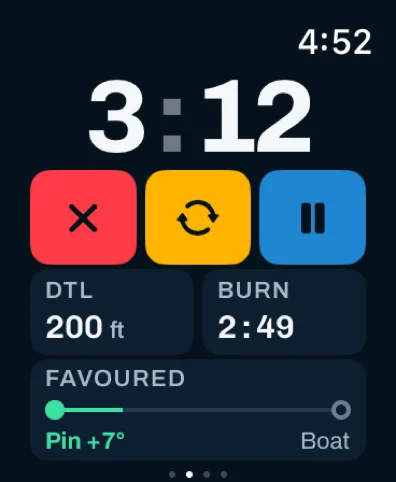
The number is only as good as the wind. A forecast wind covers a grid square, not your patch of water, and a few degrees of error in the wind is a few degrees of error in the bias. Take the wind on the water, head to wind, before you trust the favored end.
Questions
What does "pin favored" mean?
That the pin end of the start line — the buoy at the opposite end from the race committee's boat — is further upwind than the committee-boat end, so a boat starting there is closer to the windward mark.
How do you calculate start line bias?
Take the compass bearing of the line, add or subtract 90° to get the direction square to it on the upwind side, and compare that with the wind direction. The difference in degrees is the bias, and the end the wind has swung toward is favored. The distance it's worth is the line length times the sine of the bias.
How much is a 5° line bias worth?
About 9 metres (29 feet) on a 100 m line and 17 metres (57 feet) on a 200 m line — roughly line length × 0.087.
Should I always start at the favored end?
No. If the gain is under a boat length, if the fleet is crowded there, or if you want to go to the other side of the course, a fast start in clear air elsewhere on the line is usually better.
Why does the favored end change during the start sequence?
Because the line stays put while the wind shifts. Every degree the wind shifts changes the bias by one degree, so check it again in the last few minutes.
Sources
The gain formula is basic trigonometry: the favored end sits line length × sin(bias) further upwind. Boat lengths from class association specifications (ILCA 4.2 m, J/24 7.32 m). Sail Tactician behaviour from the in-app User Guide, version 3.2.
What changed
- First published.
Put a racing instrument on your wrist.
Start line, wind shifts and VMG at a glance, and a coach in your pocket afterwards. Free to download for Apple Watch and iPhone, with the full debrief on your first five races.
Download on the App Store