
The short version
- Before you go
- Read the sailing instructions. They tell you the course, the signals, the time limit and how to check in.
- The start
- Five minutes, four signals: warning, preparatory, one minute, start. Time it from the flags, not the horn. If you're over early, go back and start again.
- The rules
- Port gives way to starboard. Windward keeps clear. The boat behind keeps clear. Avoid contact, always. If you foul someone, do your turns.
- Your first goal
- Start in clear air away from the crowd, sail the right course, finish, and ask one question at the bar afterwards.
This lesson is for sailors who can tack and gybe but have never raced, and for club racers who want the basics straight.
What a club race is
A club race is run by a race committee: volunteers, usually on a committee boat at one end of the start line, who set the course, run the signals and score the finishers.
Two documents tell you how the racing works:
- The notice of race (NOR) says who can enter, when, and how to register.
- The sailing instructions (SIs) say how each race is run: the courses and how they're signalled, the start and finish lines, the time limit, how to check in, and any changes to the rules. Read them before you go out.
On the water, the committee shows the course on a course board or with flags and numbers on the committee boat. The SIs explain how to read it: which marks, in what order, and which side to leave them. If you can't work it out, sail close and ask. Most clubs also want you to sign on before racing, and some to sign off when you're back ashore.
Courses vary. Some add laps, an offset mark or a gate; see course types. The SIs always win over a diagram.
What to bring and set up
- A watch with a countdown timer, one you can start and resync with a wet hand.
- Water and a snack for a few hours on the water.
- A visible sail number. The committee scores you by it.
- Your safety kit: a life jacket you wear, and whatever your club requires.
- A handheld VHF radio, if you have one. See below.
Why a VHF radio helps. Many race committees announce postponements, course changes, recalls and the sail numbers of boats over the line on a VHF channel named in the SIs. With a handheld on board you hear it, and you can call the committee if you need to retire or need help. Pick a floating, waterproof one in a bright color so it's easy to find if it goes over the side; Cobra's BlueBound 350 comes in white with a high-visibility orange core. In US waters a recreational handheld needs no license, but check your club's rules: some classes limit radio use while racing to listening only.
Get to the starting area 30 to 45 minutes before the first warning signal; the warm-up lesson covers what to do with that time.
If the SIs ask you to check in on the water, the usual way is to sail slowly past the committee boat's stern and call your sail number, before the sequence starts.
The start sequence
Most club races use the five-minute sequence in rule 26 of the Racing Rules of Sailing:
From the preparatory signal you are racing, and the right-of-way rules apply in full. You start when any part of your hull crosses the line from the pre-start side after the start signal.
Time from the flags, not the horn. A late or missing sound doesn't change the timing. Resync your watch at the four-minute and one-minute flags.
The preparatory flag tells you what happens to a boat that's early:
 P (the usual one): if you're over at the start, go back and start again.
 I: if you're on the course side of the line or its extensions during the last minute, you must go back around one end of the line.
 Z: being in the triangle formed by the two ends of the line and the first mark in the last minute costs a 20% scoring penalty, even if you go back.

 U and black: in the last minute, being in that triangle means disqualification. Under black you also can't sail a restart of that race.
At club races you'll mostly see P; the others usually appear after a general recall. The start lesson covers how to get to the line on time and at speed, and race flags and signals shows every flag you'll see, including how starts work when several classes share the line.
If you're over the line
A boat that's on the course side of the line at the start is OCS ("on course side"). The committee then shows one of two signals:
 Individual recall: the X flag (white with a blue cross) and one sound (rule 29.1). Don't wait to be told: the rules don't require the committee to hail you, though some clubs call sail numbers or radio them. If you think it might be you, it probably is.
 General recall: the First Substitute (a yellow and blue pennant) and two sounds (rule 29.2). The whole start is cancelled; a new warning signal comes one minute after the pennant comes down.
To fix an OCS, return completely to the pre-start side of the line, then start. Under the I flag you must go around one end of the line to do it. While you're returning you have no rights: rule 21.1 says you keep clear of every boat that isn't, until you're back on the pre-start side. It costs a minute. Not going back costs you the race.
The rules you can't break
On your first day almost every encounter is one of these.
- Port gives way to starboard (rule 10). Wind over your right side, boom out to the left: you're on starboard. On opposite tacks, port keeps clear. More in port vs starboard.
- Windward keeps clear (rule 11). On the same tack and overlapped, the boat further upwind keeps clear. More in the windward-leeward rule.
- Clear astern keeps clear (rule 12). On the same tack and not overlapped, the boat behind keeps clear.
- While tacking, keep clear (rule 13). From head to wind until you're close-hauled on the new tack, you keep clear of everyone.
- Avoid contact (rule 14). Every boat, right of way or not, must try to avoid a collision. Right of way is not permission to hit someone.
- A new right of way comes with room (rule 15). If you've just gained right of way, by tacking onto starboard or overlapping to leeward, give the other boat room to keep clear.
- Changing course comes with room (rule 16.1). A right-of-way boat that changes course must give the other boat room to keep clear.
- Room at a mark (rule 18). Around every mark is a zone: the water within three hull lengths of it. Roughly: a boat that's overlapped inside you when the first of you reaches the zone gets mark-room, which is room to sail to the mark, round it, and leave it astern. A boat clear ahead when it reaches the zone gets mark-room too. The details are in mark-room.
One exception catches every new racer: there's no mark-room at the start. The mark-room rules don't apply at a starting mark surrounded by water, like the committee boat, while boats are approaching it to start (the introduction to Section C), so squeezing in between the committee boat and a leeward boat ("barging") gets you fouled, not room.
If you foul someone
Everyone fouls someone eventually. It's normal, and nobody thinks less of a sailor who owns it:
- Hail. A quick "Sorry, taking my turns" settles it with the other boat.
- Get clear. Sail away from the fleet. While taking a penalty, you keep clear of everyone.
- Take your turns as soon as you can. A two-turns penalty (rule 44.2) is two turns in the same direction, each including one tack and one gybe. If you only touched a mark, it's one turn (rule 31).
The penalty lesson covers how to do the turns quickly. If you're fouled and the other boat doesn't take a penalty, you can protest: hail "Protest" at the time, and on boats over about 6 m (20 ft) show a red flag too (rule 60.2).
Sailing the course and finishing
Sail the marks in the order the SIs give, and leave each one on the side they say: to port means on your left as you round it.
A useful check is the string rule (rule 28): a string tracing your path from the start to the finish, pulled tight, should lie on the correct side of every mark in the right order. Wrong side of a mark? Go back and round it properly.
To finish, cross the finish line from the course side, coming from the last mark. You've finished when any part of your hull crosses the line, so the bow counts. Then clear the line: sail on through and away, out of the way of boats still finishing.
Most races have a time limit in the SIs. If you're far behind, keep going: last place scores better than "did not finish."
Beginner tactics that actually help
- Start away from the crowd. Pick the less crowded end, or the back third of the line, in clear air. Be a little late and fast rather than early and stopped.
- Go at full speed. At the gun, sail fast. Don't pinch.
- Follow the fleet on the first beat. Until you can read the wind, go where most of the fleet goes.
- Say "Starboard!" early. Hail a converging port boat well before it matters.
- Give way early and clearly. When you're keeping clear, decide early and make it obvious: duck behind, or tack well away.
- Ask. The committee and your fleet captain want new racers back. Ask them anything.
- Ask a top sailor one question afterwards. Make it specific: "Why did you go left on the first beat?"
Etiquette and safety
- Help anyone in danger (rule 1.1). If helping costs you places, you can ask for redress (a score adjustment) afterwards.
- Keep clear of capsized boats (rule 22). If possible, avoid a boat that's capsized, anchored or aground, or one that's helping someone. Capsizing yourself is normal in dinghies: see capsize recovery.
- Retire if you broke a rule and didn't take a penalty. That's how the sport polices itself.
- If you stop racing, tell the committee. Tell them on the water or ashore. Otherwise they may go looking for you.
Keelboat notes. Keelboats take longer to stop and turn, so decide to give way earlier, and agree who calls time in the sequence.
Doing it with Sail Tactician
Start simple: Black Box mode
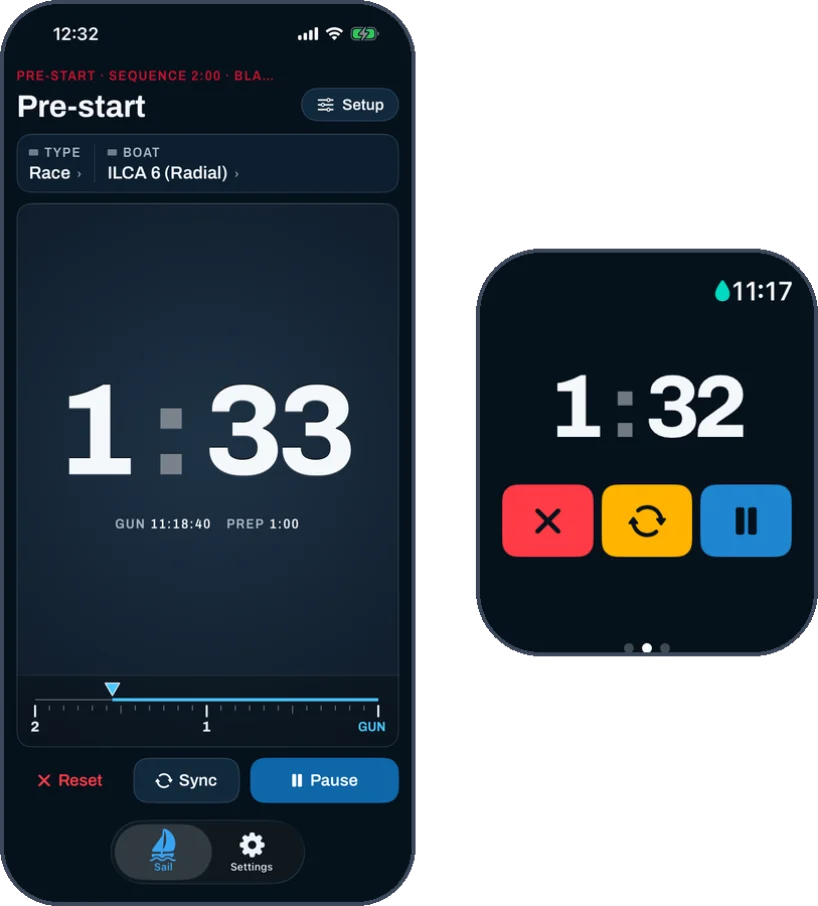
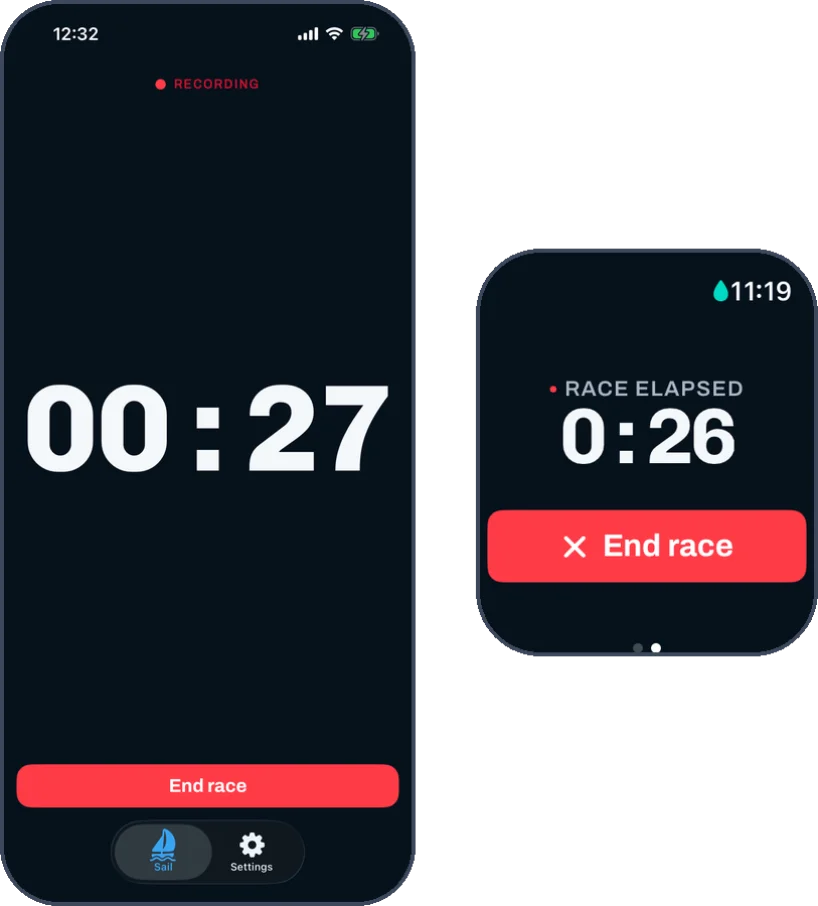
For your first few races, turn on Black Box. It gives you the countdown and, after the gun, just the elapsed time — no distance to the line, no favored end, no numbers to read. That's deliberate: in a first race your attention belongs on the boat, the wind and the boats around you, not on a screen. Keep your head up, steer, trim, and look around.
Setup is shorter too. Black Box skips the wind and line steps, so it's open the app, set the minutes, and Start when your class flag goes up. It works on an iPhone, an Apple Watch, or both together — a phone in a dry bag or on a mount, a watch on your wrist. Switch it on in Settings → Race (or Setup → Layout from the Sail tab); it syncs between your devices, and it's free.
Nothing is lost. The race is still recorded in full — track, speed and every tack and gybe — and the whole debrief is waiting in the Logbook afterwards. One thing to know: a race recorded on the watch alone saves no wind direction, so add it afterwards on the iPhone from the session's map to unlock the wind-based cards.
When you're ready for more
When starting feels routine, turn Black Box off and let the app help with the line. Sail Tactician is the start watch, the line and the debrief in one app.
Questions
What do I need for my first sailboat race?
A boat you can sail, a visible sail number, a buoyancy aid, a watch with a countdown timer, water, and the sailing instructions. Register or sign on the way the notice of race and sailing instructions say.
What happens if I start early?
You're OCS, on the course side, and the committee shows the X flag for an individual recall. Return completely to the pre-start side of the line, keeping clear of every other boat while you do, then start. Under the I flag you must go around one end of the line.
Who has right of way in sailboat racing?
On opposite tacks, starboard has right of way over port (rule 10). On the same tack, the leeward boat has right of way over the windward one (rule 11), and the boat clear ahead over the boat clear astern (rule 12). Every boat must still try to avoid contact (rule 14).
What do I do if I hit another boat?
If you were in the wrong, hail that you're taking your turns, sail clear of other boats, and do a two-turns penalty as soon as you can. If you only touched a mark, it's one turn.
Sources
The Racing Rules of Sailing 2025–2028 (World Sailing): rules 1.1, 10–16, 18, 21.1, 22, 26, 28, 29, 30, 31, 44 and 60.2 and the definitions of Start, Finish and Zone, described here in our own words. Club race procedure (notice of race, sailing instructions, check-in) is standard US Sailing club practice. Sail Tactician behaviour from the in-app User Guide, version 3.2.
What changed
- First published.
Put a racing instrument on your wrist.
Start line, wind shifts and VMG at a glance, and a coach in your pocket afterwards. Free to download for Apple Watch and iPhone, with the full debrief on your first five races.
Download on the App Store