
The short version
- What VMG is
- Velocity made good: how fast you're actually getting upwind (or downwind), not how fast the boat is moving. VMG = boat speed × cos(angle to the wind).
- Why it matters
- Point higher and the boat slows; foot off and it speeds up but sails further. VMG tells you which trade is paying.
- In Sail Tactician
- Live VMG, a target heading for your boat class, a steering cue and TACK / GYBE calls on Apple Watch and iPhone. After the race, VMG charts, your sailed angles and how much of your speed you made good.
- Free or Pro
- Live VMG with tack and gybe calls is Pro. The post-race VMG analysis is part of the full debrief, free on your first five sessions.
What is VMG in sailing?
No boat can sail straight into the wind. Upwind you zig-zag, sailing at an angle to the wind on each tack. Your boat speed tells you how fast you're moving through the water. It doesn't tell you how fast you're getting to the windward mark. That's velocity made good.
VMG is the part of your speed that points straight upwind (or straight downwind on a run):
VMG = boat speed × cos(angle to the wind)
| Boat speed | Angle to wind | VMG |
|---|---|---|
| 6.0 kt | 40° | 4.6 kt |
| 6.0 kt | 45° | 4.2 kt |
| 6.5 kt | 50° | 4.2 kt |
| 6.5 kt | 60° | 3.3 kt |
Rounded. Illustrative numbers, not a polar for any particular boat.
The angle trade-off
The table shows the whole problem. Sail higher and more of your speed points upwind, but the boat slows down. Sail lower and the boat speeds up, but more of that speed goes sideways. Somewhere between is the angle where VMG is highest. That's the angle you want to hold, and it shifts with the wind strength: wider in light air, higher in a breeze.
Downwind it's the same trade in reverse. Sail dead downwind and every knot points at the leeward mark, but most boats are slow there. Heat up and the boat goes faster but sails further. The best downwind VMG is usually some way off dead downwind.
VMG vs VMC
VMG is measured against the wind. VMC, velocity made good on course, is measured against the mark. On a square beat they're the same thing. When the mark isn't straight upwind, they differ, and VMC is the one that gets you there. Sail Tactician's live VMG is relative to the wind.
Live VMG in Sail Tactician
Pick your boat class and the app knows your target upwind and downwind angles. More than 50 presets ship, with angles from published polars and class documentation; see boat profiles. They're set for moderate wind, so save your own boat with your own angles if you want to dial them in.
On the watch, the Tactical row shows your course over ground, the target heading for your class, and the correction to get there, with which way to turn. The VMG row shows VMG, speed over ground and your true wind angle. You choose which rows go on which page.
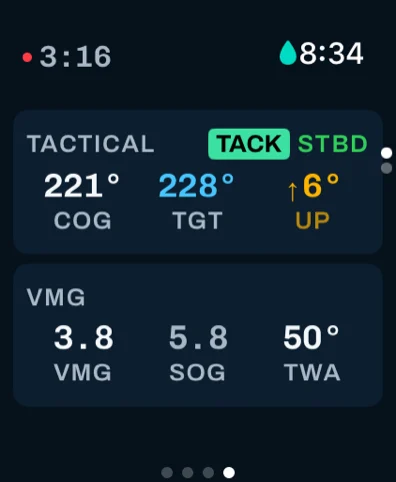
On the iPhone, add VMG to any race view, and the VMG Steering Cue for one line telling you where to steer: IN THE GROOVE in green within 3° of target, otherwise an arrow, an action and the degrees. The steering words come from the angle you're sailing, not from which way the correction points, so HEAD UP and BEAR OFF mean the same thing on either tack, upwind or down. VMG is measured along the leg: positive toward the wind on a beat, positive away from it on a run.
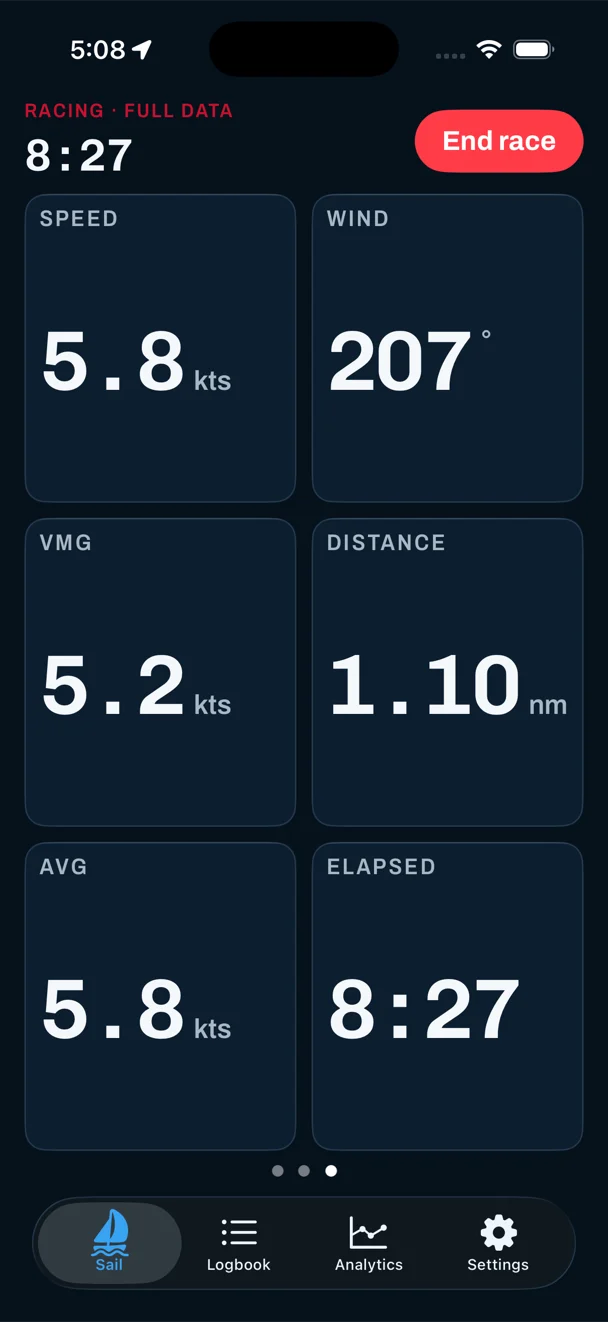
When it says TACK or GYBE
On a beat, TACK means you've had to bear away at least 5° from the course you've been sailing on this tack over the last few minutes, and held it for about 15 seconds: a header. It's measured against your own course, not the class angle, so a boat in the groove isn't told to tack because it makes a few degrees of leeway.
GYBE means you've been sailing at least 5° hotter than your class's run angle. Neither appears on a reach. The call is a prompt, not an order: whether to tack also depends on the fleet, the laylines and where the next shift is coming from. The racing course guide has the bigger picture.
With wind-shift tracking (also Pro), the live numbers follow the breeze. After a few minutes of beating on both tacks, the app's estimate takes over the target heading, never wandering more than 30° from the wind you set.
Only as good as the wind
Every VMG number depends on knowing where the wind is. A forecast covers a grid square and is often 20–30° out at a lake or near a shore. Before the start, use Point to Wind: bow into the wind, one tap. The thirty seconds pay for themselves in every number after, and the same wind sets the favored end before the start.
VMG after the race
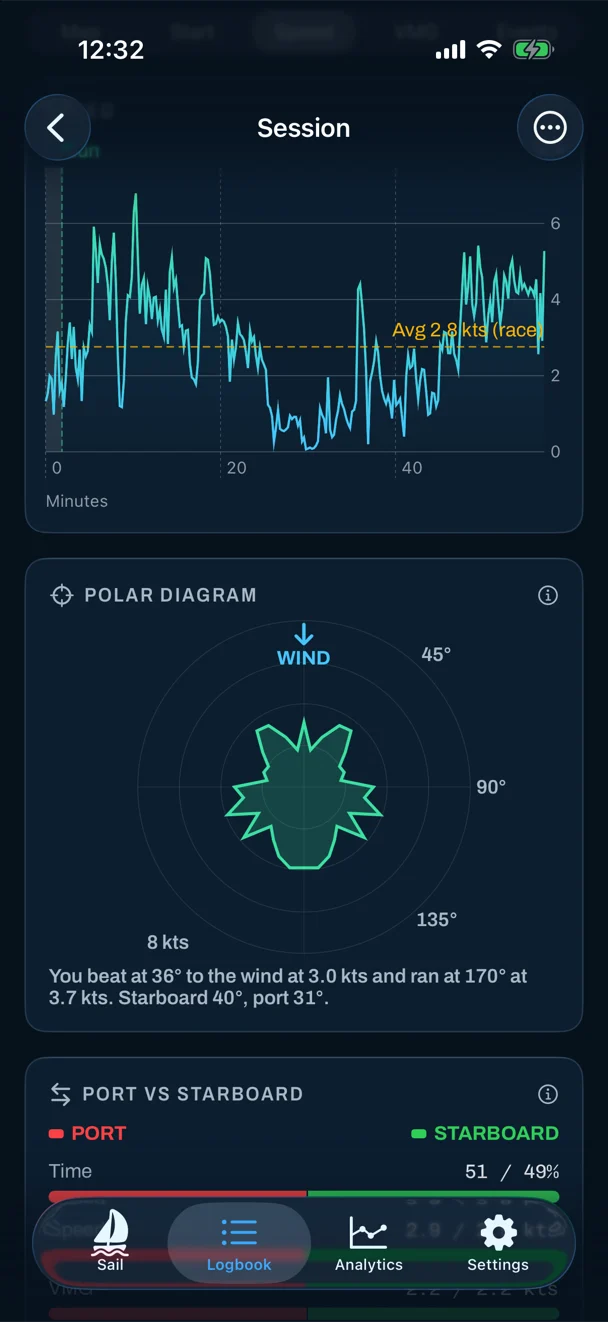
Every race is recorded, and with a wind set, the iPhone's session detail adds:
- VMG over time from the gun.
- Polar Diagram — speed by heading, ending with the angle you actually held on the beat and the run, each tack shown separately. These are medians over steady stretches, not one lucky fix.
- Upwind vs Downwind — time, distance, speed and VMG on each, and how much of your speed you made good. 72% upwind means the rest went to angle.
- Port vs Starboard — whether one tack was faster, VMG included.
No wind on the day? Set it afterwards on the session map, or better, place the windward mark where you rounded. The bearing from the start to the mark is the wind. Guessing it from the track alone is unreliable: on nine real races with a known wind, the track-only estimate came out reversed on five. The map badge reads mark or est so you know which you're looking at.
Across a season, the Analytics tab tracks your best upwind and downwind VMG as a 90th-percentile figure: what you hold when it's going well. More on the debrief in what Sail Tactician does differently, and on the watch itself in the Apple Watch sailing app.
Questions
What is VMG in sailing?
Velocity made good: the part of your boat speed that takes you directly upwind or downwind. It's boat speed times the cosine of your angle to the wind.
How do you calculate VMG?
Multiply boat speed by the cosine of the angle between your course and the wind. At 6 knots and 45° to the wind, VMG is about 4.2 knots.
What's the difference between VMG and VMC?
VMG is your speed toward or away from the wind. VMC is your speed toward the mark. They're the same on a square beat and differ when the mark isn't directly upwind.
Is there an app that shows VMG on Apple Watch?
Yes. Sail Tactician shows live VMG, a target heading for your boat class and tack and gybe calls on Apple Watch and iPhone with Pro, at $4.99 a month or $29.99 a year with the first month free.
Why does my VMG look wrong?
Usually the wind is off. VMG is measured against the wind direction you set, and a forecast can be 20 to 30 degrees out on your patch of water. Point the bow into the wind and set it on the water.
Sources
The VMG formula is basic trigonometry; the table values are illustrative. Sail Tactician behavior is from the in-app User Guide, version 3.2, also available as the full user guide. The reversed-estimate figure is from the developer's testing on nine real races with a known wind.
What changed
- First published.
Put a racing instrument on your wrist.
Start line, wind shifts and VMG at a glance, and a coach in your pocket afterwards. Free to download for Apple Watch and iPhone, with the full debrief on your first five races.
Download on the App Store