
The short version
- What the groove is
- The angle and speed together that get you to the windward mark soonest. It isn't the highest you can point or the fastest you can go.
- How to find it
- Sail fast first, then head up slowly until the boat starts to slow, then bear away a touch. Use the telltales, the heel and the feel of the helm to hold it.
- The two ways out of it
- Pinching: sailing too close to the wind and losing speed. Footing too far: sailing fast but too wide of the wind.
- Change gear
- Flat water and a steady breeze reward pointing. Waves, chop and very light air reward a little more speed.
A word about "wind" in this guide. Your sails, and every telltale on the boat, respond to the apparent wind — the wind you feel on a moving boat, which is stronger and further forward than the true wind upwind, and moves with every puff and lull. See true wind vs apparent wind.
What the groove is
A sailboat can't sail straight into the wind, so it gets upwind by zig-zagging: sailing as close to the wind as it usefully can on one tack, then tacking and doing the same on the other. Sailors call this close-hauled, and the leg of the course you sail this way is the beat.
Close-hauled isn't one fixed angle. Point a few degrees higher and the boat slows; bear away a few degrees and it speeds up. Somewhere in between is the angle where you get upwind fastest, and when you're on it the boat feels balanced: the helm is light, the heel is steady, the sails are full and quiet. That narrow band is the groove. The skill of upwind sailing is finding it, and then staying in it through every wave, gust and lull for the length of the beat.
Why the fastest way upwind isn't the highest
What matters on a beat isn't how fast the boat is going, or how close to the wind it points, but how fast it's getting upwind. That figure is called VMG — velocity made good — and it's your boat speed multiplied by the cosine of your angle to the wind.
That makes it a trade. Point higher and more of your speed goes upwind, but there's less speed to share. Bear away and you're faster, but more of the speed goes sideways. The groove is where the trade comes out best.
One thing worth knowing: the angle you steer isn't quite the angle you travel. A boat slips sideways a little as it sails upwind (that's leeway). Measured on Sail Tactician's own race recordings — a small sample — boats tracked roughly 7° wider over the ground than their class's published angle: a 43° boat made about 50° across the water. So if your GPS course looks wider than the textbook number, that's normal, not a sign you're sailing badly.
Pinching and footing
Pinching
Pinching means sailing too close to the wind for the speed you have. The bow is high, which feels like progress, but the front of the sails is starting to lift, the boat slows and the heel comes off. Slow boats also slip sideways more, so you lose twice. Pinching is the most common upwind mistake in club fleets, because a high bow looks fast.
Signs: the windward telltales on the jib lift or spin, the boat feels dead and upright, and boats around you roll past.
Footing
Footing means bearing away a little below close-hauled for extra speed. A little is often right — in waves, in light air, or to get clear of a boat's wind. Too much is just sailing fast in the wrong direction: you pass boats and then find they've tacked and crossed in front of you.
Signs: the leeward telltales on the jib stall or droop, the boat heels more, the helm loads up, and the speed is good but you aren't climbing on the boats beside you.
How to find the groove
- Get the boat going first. Bear away a few degrees with the sails trimmed for close-hauled, and let the speed build. You can't find the groove from a standstill.
- Head up slowly. A degree or two at a time, keeping the heel steady. The speed holds for a while, then starts to drop.
- Bear away a touch from there. The point just before the speed falls off is the groove. Note the heading on the compass if you have one.
- Steer to the telltales. In the groove, the jib's windward and leeward telltales both stream aft, with the windward one just starting to flick upward now and then. See how to use telltales.
- Keep the heel constant at your class's fast angle. In most dinghies and small keelboats that's close to flat: an ILCA, Opti or 420 goes fastest with only a little heel. Too much heel makes the helm heavy and the boat slip sideways; dead flat in light air can make the sails hard to fill. Scows and catamarans are the exception. A scow like the MC is sailed with a deliberate, steady heel onto its leeward chine (the hard edge of the hull), and a cat with the windward hull just kissing the water. The rule is the same: pick the angle and hold it.
Then use the other boats: a boat close by on the same tack is the best speed test there is.
Changing gear for the conditions
The groove moves with the wind and the water. Thinking in gears helps:
| Conditions | Steer for | Why |
|---|---|---|
| Very light air | A little more speed, a little lower | The sails need flow to work at all. Pointing high in a drifter just stops you. |
| Medium air, flat water | Point — the narrowest groove | The boat holds speed easily, so the angle pays. |
| Waves or chop | Bear away slightly and keep the speed up | Each wave knocks speed off. You need power to punch through. |
| Strong wind | Depower the sails and point, feathering in gusts | The boat is already at full speed; extra power only adds heel. |
Feathering means heading up very slightly in a gust so the front of the sails just lifts, letting off excess power without losing speed.
In gusts, the wind usually swings slightly aft as well as getting stronger, so you can head up a little; in lulls, bear away a little to keep the speed. Trim the sails for the gear too — see how to trim the jib and trimming a single-sail boat.
Holding it for a whole beat
Finding the groove takes a minute. Holding it takes concentration, because the wind changes every few seconds. A few habits help:
- Small rudder movements. Every big correction acts as a brake. If you're steering a lot, the trim is probably wrong.
- Look ahead for waves and pressure — darker patches on the water — so you're ready for them instead of reacting.
- Don't chase the compass. In a shifting breeze the right heading changes. The groove is an angle to the wind, not a number on the compass — use the compass to spot shifts, as in playing the shifts.
When to tack: what the app tells you
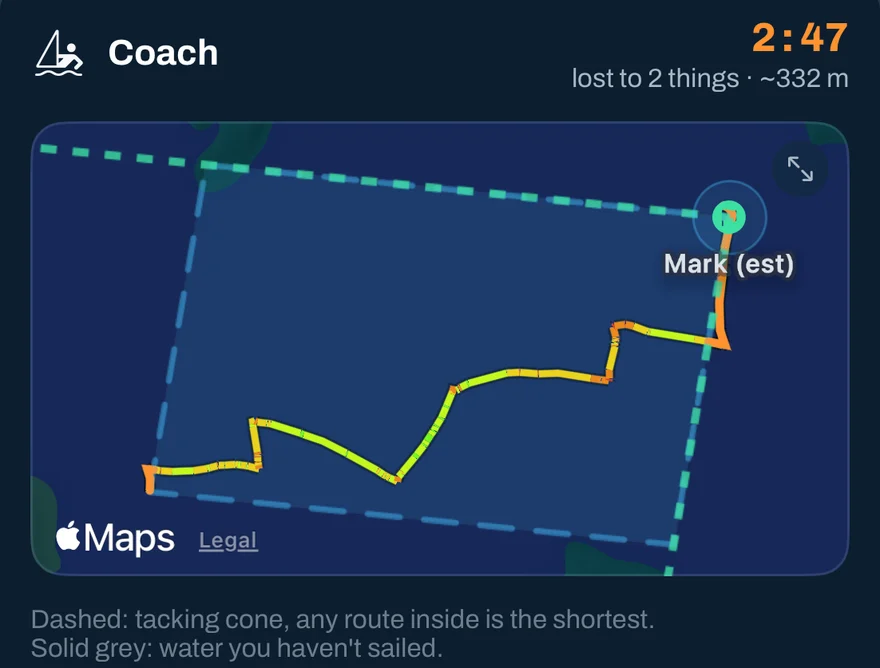
Holding the groove tells you how to sail the tack you're on. The other half of the job is knowing when to leave it. Sail Tactician watches the angle you're actually able to sail against your boat's target angle, and when the wind heads you and stays headed, it prompts you to tack.
- On Apple Watch, the Tactical row on a race page shows your course over ground, the target heading for this tack and the correction to steer. When you've been forced more than 5° wider than your target angle for about 15 seconds — a persistent header, not a passing wobble — a green TACK tag appears on the row. Downwind, the same row shows GYBE when you've been pushed more than 5° higher than your best angle.
- On iPhone, add the Wind Shift cell to a race view. It shows LIFT or HEAD in degrees against your own average on this tack — the number that tells you when to tack.
- On the wrist, the watch can also tap you twice when a shift of 8° or more settles in (Settings → Wind Settings → Shift Haptic), so you notice a header without looking down.
Two things to know. The call is only as good as the wind you gave the app, so set it on the water. And it's a prompt, not an order: if you're near a layline, in someone's bad air, or about to tack into a crowd, the right answer can still be to hold on.
Every VMG number is only as good as your wind. A forecast covers a wide area, not your patch of water. Take the wind on the water before you trust the cue.
Doing it with Sail Tactician
Set the wind on the water before the start (Setup → Wind → Point to Wind: bow into the wind, one tap) and choose your boat class in Settings. Every number below is measured against those two, and a forecast can be 20–30° off near a shore.
Questions
What does pinching mean in sailing?
Sailing too close to the wind for the speed you have. The bow points high but the boat slows and slips sideways, so you get upwind more slowly than you would a few degrees lower.
What is footing in sailing?
Bearing away slightly below close-hauled to sail faster. A little is useful in waves, light air or to escape another boat's wind; too much just covers extra distance.
What is the best angle to sail upwind?
It depends on the boat and the conditions — most dinghies and keelboats sail somewhere around 40–45° to the true wind, and a little wider over the ground because of leeway. The best angle is wherever your VMG is highest, which you find by heading up until the speed starts to fall off.
How do I know if I'm in the groove?
Both jib telltales stream aft, the heel is steady, the helm is light but not dead, and you're holding your own against boats around you on the same tack.
Sources
Standard club-racing practice for upwind sailing. VMG is boat speed × cos(angle to the wind). The leeway figure is measured on Sail Tactician's own race recordings, a small sample. Sail Tactician behavior from the in-app User Guide and training guide, version 3.2.
What changed
- First published.
Put a racing instrument on your wrist.
Start line, wind shifts and VMG at a glance, and a coach in your pocket afterwards. Free to download for Apple Watch and iPhone, with the full debrief on your first five races.
Download on the App Store